
Immunity & Infection




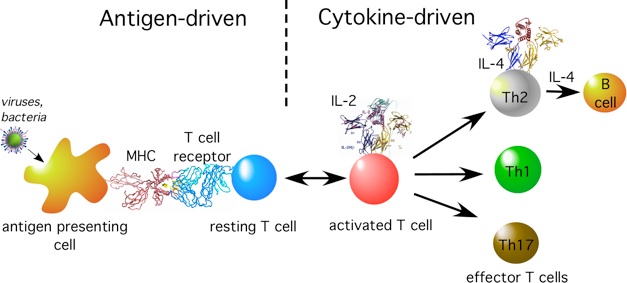
We have a long-standing interest in molecules that mediate, regulate and intersect with the antigen-specific and cytokine-driven phases of cellular and humoral immunity. We are interested in how receptors in these systems contribute or mediate diseases such as autoimmunity and cancer,
In the antigen-specific phase of Immunity we are interested in how both alpha-beta and gamma-delta T cell receptors recognize and signal in response to their self and foreign ligands, comprising both MHC and non-MHC antigens. A question that is currently of high interest in the lab is the relationship between the structural mode of TCR/MHC interaction to signaling and cross-reactivity. We are approaching this question using novel methods of peptide ligand discovery based on yeast surface display of peptide-MHC, which allows us to quantify TCR cross-reactivity. This system is also being applied to the identification of endogenous peptide ligands for “orphan” TCRs that are important in immune disease, such as autoimmune TCRs, TCRs resident on tumor infiltrating lymphocytes, and protective TCRs expanded during viral infection.
T cell and B cell homeostasis is largely determined by the actions of cytokines. We are interested in how shared cytokine receptors, such as gp130, common gamma chain, Interferons, and Interleukin-17 receptors are activated by a range of structurally diverse Interleukins and cytokines, and subsequently communicate intracellular signals to membrane-proximal second messengers in a context-dependent fashion. We have an emerging effort to engineer cytokines with novel signaling activities using combinatorial biology in order to better understand the relationship between extracellular receptor-ligand complex architecture, and intracellular signaling potency.
Stem cell biology and regenerative medicine share an intimate relationship with factors that control Immune homeostasis. We have several programs underway to investigate molecular aspects of receptor-ligand systems that control lineage decisions of stem cells, and influence stem cell engraftment.
A relatively new area involves a collaboration with the group of Professor Irv Weissman to investigate molecular aspects of macrophage phagocytosis mediated by the “don’t eat me” signal. The CD47/SIRP receptor-ligand axis serves as a toggle switch that, on one hand, enables macrophages to destroy cancer cells. However, this same mechanism results in the destruction of newly engrafted stems cells, which is a major problem for bone marrow transplantation. We are attempting to use structure and engineering to toggle the “don’t eat me” signal on or off, depending on the desired therapeutic endpoint.